

BioPure by Doctor Rhonda
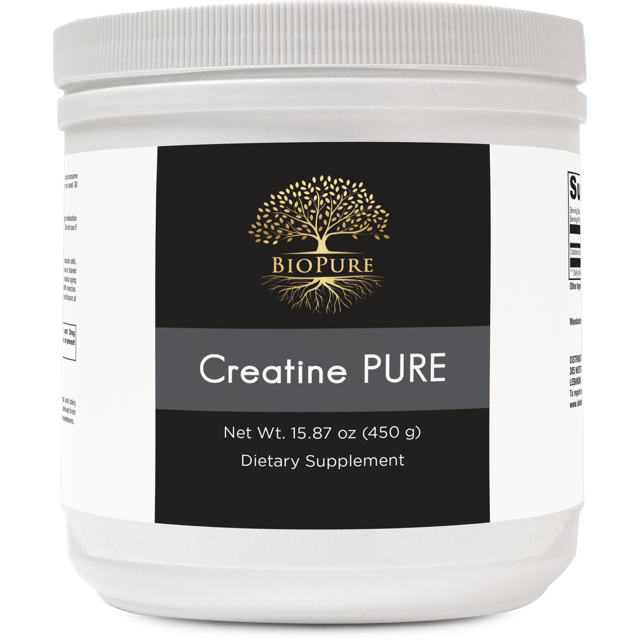
Creatine Pure
Creatine Pure
Couldn't load pickup availability
Discussion
• Supports Muscle Performance*
• Supports Brain Function*
• Supports Cellular Energy Production*
• Supports Lean Muscle Mass*
Clinical Applications
*These statements have not been evaluated by the Food and Drug Administration.
This product is not intended to diagnose, treat, cure, or prevent any disease.
Creatine PURE plays a vital role in the energy production process in muscle cells, making it the perfect supplement
to fuel muscle health. Whether you are a trained athlete or simply want to help maintain lean muscle mass during
the natural aging process, creatine supports muscle performance when combined with exercise. Creatine may
also support cognitive function, helping to keep both brain and brawn at peak performance.*
Creatine PURE features pure creatine monohydrate, an extensively studied supplemental form of creatine.
This compound has a well-established vital role in cellular energy production, helping to fuel muscle health in
people of all ages and athletic abilities.1 Creatine stores phosphate groups as phosphocreatine, which then
donates the phosphate groups to adenosine diphosphate (ADP) to regenerate it to adenosine triphosphate
(ATP), the primary cellular energy source. Approximately half of the creatine needed by the body is produced
endogenously from the amino acids arginine, glycine, and methionine. Creatine can also be obtained through
dietary sources, primarily meat and fish. Individuals who consume a predominantly plant-based diet have been
suggested to have lower creatine accumulation and a greater response to creatine supplementation.*2,3
Although 95% of creatine is stored in muscles, it is also found in heart, brain, kidney, retinal, and testicular tissues.
Creatine levels can be impacted by diet, physical activity, and a natural decline that occurs with aging. The body
metabolizes 1% to 2% of stored creatine daily into the waste product creatinine, which is excreted in the urine.2,4
The primary benefit of creatine supplementation is to replenish cellular energy by raising phosphocreatine to
accelerate the recycling of ADP to ATP, which is how it helps support muscle performance.5 However, other
tissues that store creatine may also benefit from enhanced cellular energy production. Individual responses to
creatine supplementation can vary based on diet, body composition, and intensity of physical activity.*2,6
Creatine Supplementation Approaches
Creatine loading refers to a supplementation strategy used to increase creatine stores in skeletal muscle
and involves supplementing with an oral dosage of 20 to 25 g/d for 5 to 7 days.2,5 Creatine loading doses
are typically divided into 4 to 5 servings per day, a practice found to help mitigate gastrointestinal distress
associated with doses over 10 g.7 The loading phase is followed by a daily lower maintenance dose of 3 to 5
g.8 A 1996 landmark study comparing creatine loading with an everyday maintenance dose found that creatine
accumulation in muscle was similar when consumed as a dose of 3 g for 28 days or as 20 g for 6 days.9 Dosage
recommendations and whether to load for a short period or take a smaller dose for a longer period may depend
on the goal of the individual,8 but it has been established that both loading- and maintenance-dose strategies
can increase creatine stores in skeletal muscle.*3
Muscle Performance
A substantial body of research has established a role for supplemental creatine in fueling muscles and exercise
performance in individuals from across diverse populations and with varying levels of physical activity. Creatine
supports muscle performance by boosting ATP production to help muscles contract when anaerobic activity is
initiated and helping to maintain a continuous energy supply to the muscle cells when exercising.*2,5
Athletes
In a randomized trial in football players (N = 16) designed to assess the long-term effects of creatine on strength
and power indices during resistance training, subjects were given 5 g of creatine once daily for 10 weeks. The
results showed significant increases in muscle performance, strength, and lean body mass, establishing the
benefit of low-dose creatine on muscle performance without a loading phase.*10
Continued on next page
Creatine PURE
Creatine PURE
All DOCTOR RHONDA Formulas Meet or Exceed cGMP Quality StandardsYoung Adult Men
In a study of healthy men (N = 58) aged 21 ± 2 years who regularly engaged in varying levels of recreational
exercise, it was found that 5 g of creatine once daily for 30 days, in combination with resistance training, led to a
significant improvement in body mass, mean power, and leg and bench press strength. These results indicate a
benefit to muscle performance post-creatine supplementation.*11
Older Women
In a study assessing the effect of creatine combined with resistance training on strength, performance, and body
composition in older women (N = 18), subjects were given 5 g of creatine or placebo once daily for 12 weeks.
Results indicated an improvement in muscle performance and lean muscle mass in older women when creatine
was combined with resistance training.*12
Older Adults
In a pilot study in healthy male and female adults (N = 26) over age 60, researchers sought to establish the
effect of strength training when combined with 5 g/d of creatine for 16 weeks. Using a hand dynamometer to
measure strength and a questionnaire designed to assess cognitive performance, it was determined that creatine
supplementation results in improvements in both strength and cognitive function.*13
Cognitive Function
The functional role of creatine in cellular energy metabolism, combined with its well-established role in muscle
performance, has led to additional studies evaluating its potential to boost brain performance.*14,15
In a placebo-controlled trial in young vegetarian adults (N = 45), the effect of creatine on intelligence test scores
and working memory performance was assessed. Subjects were given 5 g/d of creatine for 6 weeks, which
significantly affected working memory and intelligence tasks. These results suggested a beneficial effect of
creatine on mental performance.14 In a larger study (N = 148) that replicated the same design and treatment but
included a larger range of cognitive function assessments, creatine was found to have a small beneficial effect.
Although the authors did not come to strong conclusions, they suggested that the role of creatine on cognitive
performance should be further investigated, given that a small effect could have larger benefits when scaled over
time to a larger population group.*15
In a double-blind, placebo-controlled trial, the effect of short-term creatine supplementation on cognitive
performance was assessed in healthy young adults (N = 24). It was found that cognitive decline associated with
mental fatigue, as measured by a standardized calculation test, was reduced with creatine supplementation of 8
g/d for 5 days.*16
Studies have suggested that creatine supplementation may promote cognitive function in the aging population.17,18
A meta-analysis of data from 8 randomized trials in older adults aged 66 to 76 found that creatine supplementation
enhanced measures of memory performance regardless of dose, duration of intervention, sex, or geographical
location.17 Another meta-analysis of 16 randomized trials with subjects ranging in age from 20 to 76 indicated
that creatine may confer beneficial cognitive effects, particularly in the domains of memory, attention time, and
processing speed. However, the authors suggested further research to elucidate dose, intervention duration, and
precise mechanisms of action.*18
Overall, a link between creatine and cognitive function has been noted in the research; however, additional and
more robust trials are needed to further validate the impact of creatine supplementation on enhanced cognitive
function.*
Lean Muscle Mass
In addition to muscle performance and cognitive function, studies have also explored a role for supplemental
creatine in promoting lean muscle mass. In the aging population, creatine has been demonstrated to improve the
quality of life by increasing muscle strength and resistance to fatigue. It has also been demonstrated to increase
lean body mass in both younger and older adults when combined with resistance training.*19,20
In a 12-week, parallel-group, double-blind trial, subjects (N = 32) aged 60 to 80 were given 5 g/d of creatine or
placebo after resistance training sessions. Participants were assessed for lean mass and strength using dual-
energy X-ray absorptiometry (DXA) and 10-repetition maximal tests. Results indicated a significant gain in lean
muscle mass when creatine supplementation was combined with resistance training.*21
In a meta-analysis of 19 studies in adults over age 50 (N = 609), the combined effect of creatine supplementation
and resistance training was compared with resistance training alone. Results suggested that creatine combined
with resistance training has the potential to contribute to a greater reduction in body fat percentage.*22
A meta-analysis of data from randomized clinical trials in generally healthy young, middle-aged, and older adults
suggested that 5 to 20 g of creatine daily for up to 48 weeks, combined with resistance exercise, increased lean
body mass regardless of age. Neither statistical nor clinical significance in lean body mass was documented for
creatine supplementation without exercise.*19
This formulation is designed to provide a daily maintenance dose of creatine to fuel and replenish cellular energy
production in tissues where creatine is stored. Widely used by both athletes and individuals concerned about
age-related lean muscle loss, creatine supports muscle performance and may also support cognitive function.*Serving Size: 1 Scoop (about 5 g)
Servings Per Container: About 90
** Daily Value not established.
Supplement Facts
Amount Per Serving %Daily Value
5 g
Creatine monohydrate **
Other Ingredients: None.
Creatine PURE 90 Servings
REV. 12/08/25
*These statements have not been evaluated by the Food and Drug Administration.
This product is not intended to diagnose, treat, cure, or prevent any disease.
DRS-369
Directions
Dissolve 1 level scoop in 8 oz of water or other beverage and
consume once daily, or use as directed by your healthcare
professional. Can be used 30 minutes before exercise or
immediately following exercise.
Consult your healthcare professional prior to use. Individuals
taking medication should discuss potential interactions with their
healthcare professional. Do not use if tamper seal is damaged.
References
Formulated To Exclude
Wheat, gluten, corn, yeast, soy, animal and dairy products, fish, shellfish, peanuts, tree nuts, egg, sesame, ingredients derived from genetically
modified organisms (GMOs), artificial colors, and artificial sweeteners.
1. Dietary Supplements for Exercise and Athletic Performance Fact Sheet. Updated April 1, 2024. Accessed February 19, 2025. https://ods.od.nih.gov/factsheets/ExerciseAndAthleticPerformance-HealthProfessional/
2. Kreider RB, Stout JR. Nutrients. 2021;13(2):447. doi:10.3390/nu13020447
3. Antonio J, Brown AF, Candow DG, et al. J Int Soc Sports Nutr. 2025;22(1):2441760. doi:10.1080/15502783.2024.2441760
4. Smith RN, Agharkar AS, Gonzales EB. F1000Res. 2014;3:222. doi:10.12688/f1000research.5218.1
5. Wax B, Kerksick CM, Jagim AR, et al. Nutrients. 2021;13(6):1915. doi:10.3390/nu13061915
6. Bonilla DA, Kreider RB, Stout JR, et al. Nutrients. 2021;13(4):1238. doi:10.3390/nu13041238
7. Ostojic SM, Ahmetovic Z. Res Sports Med. 2008;16(1):15-22. doi:10.1080/15438620701693280
8. Antonio J, Candow DG, Forbes SC, et al. J Int Soc Sports Nutr. 2021;18(1):13. doi:10.1186/s12970-021-00412-w
9. Hultman E, Söderlund K, Timmons JA, et al. J Appl Physiol (1985). 1996;81(1):232-237. doi:10.1152/jappl.1996.81.1.232
10. Pearson DR, Russel DG, Harris T. J Strength Cond Res. 1999;13(3):187-192.
11. Herda TJ, Beck TW, Ryan ED, et al. J Strength Cond Res. 2009;23(3):818-826. doi:10.1519/JSC.0b013e3181a2ed11
12. Aguiar AF, Januário RS, Junior RP, et al. Eur J Appl Physiol. 2013;113(4):987-996. doi:10.1007/s00421-012-2514-6
13. Smolarek AC, McAnulty SR, Ferreira LH, et al. JEPonline. 2020;23(4):88-94.
14. Rae C, Digney AL, McEwan SR, et al. Proc Biol Sci. 2003;270(1529):2147-50. doi:10.1098/rspb.2003.2492
15. Sandkühler JF, Kersting X, Faust A, et al. BMC Med. 2023;21(1):440. doi:10.1186/s12916-023-03146-5
16. Watanabe A, Kato N, Kato T. Neurosci Res. 2002;42(4):279-285. doi:10.1016/s0168-0102(02)00007-x
17. Prokopidis K, Giannos P, Triantafyllidis KK, et al. Nutr Rev. 2023;81(4):416-427. doi:10.1093/nutrit/nuac064
18. Xu C, Bi S, Zhang W, et al. Front Nutr. 2024;11:1424972. doi:10.3389/fnut.2024.1424972
19. Delpino FM, Figueiredo LM, Forbes SC, et al. Nutrition. 2022;103-104:111791. doi:10.1016/j.nut.2022.111791
20.Pashayee-Khamene F, Heidari Z, Asbaghi O, et al. J Int Soc Sports Nutr. 2024;21(1):2380058. doi:10.1080/15502783.2024.2380058
21. Pinto CL, Botelho PB, Carneiro JA, et al. J Cachexia Sarcopenia Muscle. 2016;7(4):413-421. doi:10.1002/jcsm.12094
22. Forbes SC, Candow DG, Krentz JR, et al. J Funct Morphol Kinesiol. 2019;4(3):62. doi:10.3390/jfmk4030062
Share
Excellence is our mission.
Our dietary supplements are made with the highest-quality ingredients, ensuring effectiveness and safety. Each product is carefully crafted and precise.